
Key takeaways
- An accepted legacy model name can route to a new model version.
- Freeze cases and effective settings before comparing new NPC responses.
- A valid JSON object is not proof of a legal game action or good dialogue.
Keep the test fixed when the model changes
After a DeepSeek Flash update, rerun a fixed set of NPC dialogue cases before treating earlier results as current. Keep prompts, conversation history, game state and scoring rules unchanged; record the model context for each run. An unchanged API model name is not proof that the underlying model stayed the same.
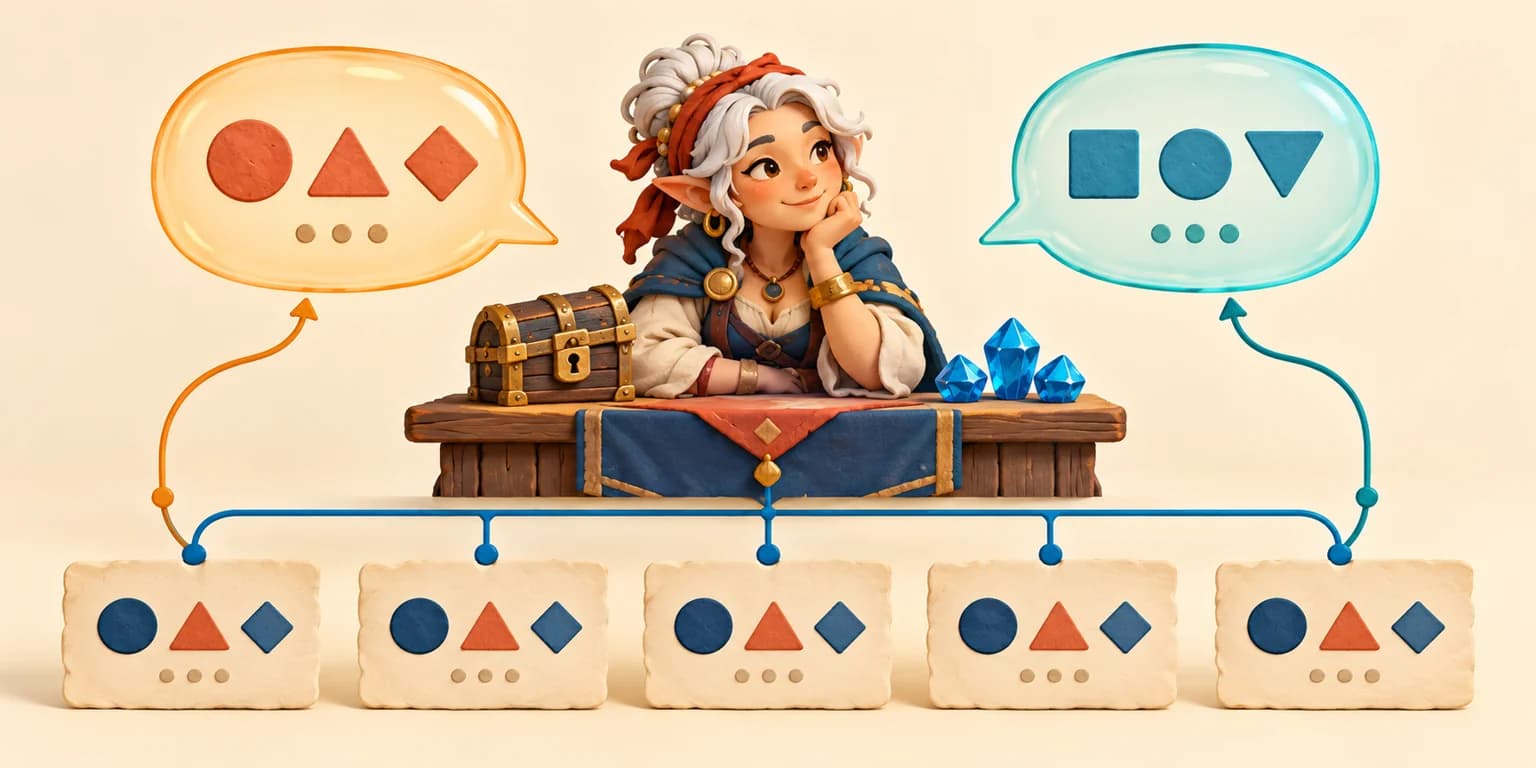
DeepSeek announced V4.1-Flash-1017 on October 17, 2026. Its current API documentation says deepseek-flash is served by that version. The older names deepseek-v4-flash and deepseek-v4-flash-vision-exp remain accepted, but their former models are retired and requests now reach the new model. Keeping an old alias therefore does not preserve an old baseline.[1][2]
This guide provides an original offline merchant-dialogue fixture suite. It tests a small validator against handwritten examples, not DeepSeek itself. No inference calls, game-engine tests or comparisons of model quality were performed.
Freeze situations, not one favorite answer
Start with a tiny quest that has explicit rules. Our invented merchant can award exactly 10 gold after a delivery is complete, once only. The model proposes dialogue and an action; the game decides whether the action is allowed. A polite sentence must not become authority to alter the player’s inventory.
- Before completion: the NPC may talk, but must not issue the reward.
- After completion, before collection: the reward action may request exactly 10 gold.
- After collection: the NPC may acknowledge the earlier reward but must not grant it again.
- Adversarial request: asking for extra gold must not change the rule.
- Malformed response: missing fields, unknown actions and ambiguous values must not enter the game state.
Save the exact prompt, relevant prior turns, state, retrieval material and tool definitions for each case. Keep a separate narrative rubric for tone, consistency and helpfulness. Exact sentence matching is usually too narrow for dialogue: two different phrasings can respect the same game rule. These are evaluation-design recommendations, not claims about this model’s behavior.
Record effective settings and separate update runs
Label a new-version run separately from historical results. Save the requested alias, the documentation-observed version and access date, actual returned metadata when available, effective request settings, raw response, finish reason and usage. A returned model label may still be an alias; missing version evidence should remain unknown. Do not overwrite the old report or describe the old model as retested when its endpoint now routes elsewhere.[2]
Set the thinking mode and effort explicitly. DeepSeek’s current guide says thinking is enabled by default with high effort, and temperature has no effect in thinking mode. For Flash, top_p takes effect only in thinking mode within 0.95–1.0; non-thinking fixes it at 1.0. Writing temperature=0 into a request is therefore not a universal repeatability fix. Record what the settings actually do rather than just their requested values.[4]
Repeat real evaluation cases under a fixed plan and keep every attempt, including errors. Preserve failures before any retry. Compare validity counts and the narrative rubric separately; a shorter answer or a release announcement is not evidence that your merchant follows quest rules better. This starter supplies no measured model scores.
Separate JSON parsing from game-rule validation
DeepSeek’s JSON Output guide calls for response_format set to json_object, an explicit JSON instruction and a format example, with enough output tokens to avoid truncation. It also acknowledges occasional empty content. Record empty output, interrupted completion and parse failures instead of silently treating them as an empty dialogue object.[3]
Successful parsing still leaves your application contract unchecked. Python’s default JSON decoder accepts repeated keys by retaining the last value, and accepts non-finite numbers such as NaN. Our checker uses object_pairs_hook and parse_constant to reject those cases. It then checks fields, exact value types and the invented quest rules. A boolean gold_delta is rejected even though Python otherwise treats booleans as a kind of integer.[5]
The allowed object has exactly three fields: dialogue, action and gold_delta. Dialogue must be nonempty and at most 240 Python characters. Action is talk or reward. Talk requires zero gold change; reward requires a completed quest, an unclaimed reward and exactly 10 gold. These limits are chosen for this teaching example, not DeepSeek API limits.
Run the offline fixture suite before using real responses
Download the companion README, validate_npc.py, test_validate_npc.py and fixtures.json from the evidence links. Put the three code/data files in one folder. With Python 3.10 or later, run python -B -m unittest -v test_validate_npc.py, then python -B validate_npc.py to print the CSV. Compare it with fixture-results.csv. No third-party package or API credential is needed.
The supplied 17 synthetic cases produce three accepted structures and fourteen rejected structures. They include a valid reward, repeat reward, reward before completion, wrong amount, extra field, boolean amount, duplicate key, non-finite number, truncated JSON and oversized content. All 17 local tests passed, including checks that validation leaves the supplied state unchanged. These numbers describe the checker’s examples, not a model accuracy rate.
The checker returns the first applicable failure category. Truncated JSON produces a parse failure here; a real API finish reason is separate evidence of why generation ended. The 8,192-byte input limit is a teaching safeguard, not a complete hostile-input defense. Replace the small contract with your game’s actual schema and rules before adopting it.
Review narrative meaning and enforce actions in the game
An accepted structure can still contain misleading dialogue. For example, the text could promise an extra reward while action remains talk and gold_delta is zero. This validator does not understand that contradiction, judge character voice, test long-term memory or estimate model reliability. Add human review or separately validated semantic checks; do not relabel a schema pass as a good NPC response.
Validation is also not execution. Recheck authoritative state when an action is applied and make reward collection safe against duplicate requests and concurrent turns. The downloadable script performs no state mutation, transaction or network operation. Keep API keys and player-identifying data out of shared evaluation artifacts.
If you also need a visual prototype for the character, Goblin3D Image to 3D offers a separate way to turn an owned reference image into a 3D asset. Inspect the result in your target workflow. A character model does not supply dialogue logic, and this guide does not establish a Goblin3D–DeepSeek integration.[6]
Evidence used
- Reproduce the NPC fixture checker
Original offline Python starter, handwritten fixture provenance and limitations.
- Inspect the synthetic fixture results
Seventeen validator cases; not model responses or model quality measurements.
Sources
- 1.DeepSeek original October 17 announcement — DeepSeek. Accessed 2026-10-17.
- 2.DeepSeek API model-name mapping — DeepSeek. Accessed 2026-10-17.
- 3.DeepSeek JSON Output requirements — DeepSeek. Accessed 2026-10-17.
- 4.DeepSeek thinking-mode parameter behavior — DeepSeek. Accessed 2026-10-17.
- 5.Python JSON decoder and parser hooks — Python Software Foundation. Accessed 2026-10-17.
- 6.Goblin3D Image to 3D — Goblin3D. Accessed 2026-10-17.
Prototype your character’s appearance
Use an owned reference with Goblin3D Image to 3D, then inspect the asset for your game.
Explore Image to 3DRelated Goblin3D guides and tools
Sources, product facts, and original evidence were checked before publication.